

Signup for our PA Travel Newsletter

Request Free PA Travel Guide

Chopped: A Charcuterie Trail

While aged may not be the most delicious-sounding adjective for most foods, when it comes to charcuterie time is the secret ingredient. So, spend some time checking out our delicious charcuterie offerings, then start planning your trip.

Select a region to view an itinerary

Pennsylvania Wilds

While charcuterie is certainly the star of this road trip, you’ll also find delicious ice creams, wines, barbeque, and even incredible woodworking pieces. So, there’s plenty of opportunity to let all PA’s smoky offerings settle while you make your way along the trail. Hit the trail…

Southeastern PA

Look no further for a three-day, non-stop, meat-inspired thrill ride. That is, if all the charcuterie you can eat is your idea of a thrill ride. And whose wouldn’t it be? Your first stop is Central Market, which offers enough delicious options to top most trips all by itself.

Pittsburgh & Laurel Highlands

With a large number of German, Italian, and Polish residents, Western Pennsylvania is well known for the caliber of its charcuterie. Each heritage offers its own expertise to the craft and the outcomes must be tasted to be believed. So, what are you waiting for? Hit the trail.

Western PA

Is there any other place you can get elk jerky? Ok, maybe a few, but none that offer delicious Straub brews and delicious PA wines in the same area. Who knows, you may be able to spot a wild elk while you’re traveling the trail!

Northeastern PA

Nothing pairs better with a scenic countryside than smoky treats, so you’re in for a treat. Kielbasa, beef sticks, knockwurst, you can find any type of cured concoction along this trail, so get out there and get adventurous.

Kielbasa

Cured meats were born of necessity.

Drying meat has long been practiced in this region and throughout the world as a method of meat preservation. Communities indigenous to Pennsylvania dried meats and made jerky from the animals that they hunted.

A mix of dried meats, berries, seeds and fat called Pemmican was a common variation. Pemmican was a nutritious mix that enabled many to thrive through harsh winters and rough treks through the mountains. While it's no longer commonly enjoyed, jerky made from venison, beef or even turkey remains a common snack throughout parts of Pennsylvania and beyond. In fact, jerky was listed as one of the hot food trends at The Specialty Foods Fancy Food Show in New York City in 2019.

Charcuterie traditions in the region evolved over time with the increasing and varied migration to the area often facilitated by the region's industrialization. Throughout the 19th and 20th centuries and today, migration from Europe, Asia, and Central and South America has influenced these practices. The Dutch were the first large group of migrants to arrive in Pennsylvania, followed by the Swedish, Finnish, British, Germans, and Scots Irish. These western European groups were followed by Italians and Eastern Europeans around the end of the 19th century. By the early 20th century, Pennsylvania was home to the second-largest Italian population in the country and had more Polish, Slovak, Croatian, Slovenian and Ukrainian residents than any other state. Nearly half of all Ukrainian migrants to the country came to Pennsylvania during this time. Pittsburgh was the Ukrainian center of the region, and today still has the fourth largest Ukrainian population in the US. Today, the largest migrant populations to Pennsylvania are arriving from India, China, and more relevantly to this trail, Mexico.
smoked-sausage

Many early migrants to Pennsylvania settled in Philadelphia, while others moved to smaller towns and rural areas to work on the railroads, in coal mines, and in the lumber industry. For those near the port of Philadelphia, imported meats from their respective homelands were often available, while others in more remote towns and rural communities tried to make their own with whatever products were available and affordable, often smoking them in their backyards and storing them in cool, underground root cellars.

For example, in rural areas throughout the 1800s, most farmers had smokehouses in their backyards in addition to smoking areas or bacon shelves in their farmhouse chimneys. Late fall and early winter was the time for hog slaughtering, because the cold weather allowed farm families to preserve meat safely. A brine of salt, vinegar and spices was often used—very similar to what is used today. The fat from the animal was rendered into soap and saved for frying and baking. After smoking, in order to keep the meat safe from bugs and vermin, they were rubbed with pepper to keep bats roosting in the chimneys from having a nibble or were covered with herbs or muslin bags to keep skipping maggots (called hoppers) from landing on them. Recipes and curing methods were adapted based on the temperature and the types of cures available.

smoked-sausage

In addition to home-curing methods, small-town markets often made kielbasa, knockwurst, liver sausage, salami, or soppressata. Many of these cured variations are still popular in Pennsylvania's butcher shops and on restaurant menus today.

Specifically, kielbasa, ring bologna, soppressata, and sweet (or Lebanon) bologna are a few of the charcuterie that make Pennsylvania unique. Additionally, few states have as many processed venison products as Pennsylvania. Due to a growing elk population in the Northern section of the state, dried and cured elk meat has become uniquely popular in our region as well. Kielbasa is a Polish smoked sausage made of pork, although sometimes it includes some beef or even turkey. Spelled many ways, including kolbasa, kielbasa, klobase, kielbasi, and kolbassi, this sausage is often garlicky and loaded with black pepper. It has a chunky texture and is usually sold pre-cooked, although a fresh version is sometimes available. Kielbasa also included hot dogs, sometimes called a "Polish sausage" or "Polish dog." In addition to the Polish, kielbasa is special to many Eastern European communities with each group having their own mix of spices and seasonings for their kielbasa.

Soppressata
Charcuterie is not a fad. Although its popularity has grown in recent years, its history dates back to the 15th century.

PA's eclectic culture contributed to our diverse charcuterie offerings.

Ring Bologna

The Pennsylvania Germans’ smokey and mildly spiced contribution to PA charcuterie.

Ring Bologna is a seasoned and precooked mix of beef and/or pork stuffed into a casing tube that is narrower than regular bologna. It's shaped into a ring and tied with string to connect the ends. It is often served sliced for eating with crackers or pickled in a mixture of vinegar and pickling spices. It's common in Pennsylvania German communities and also in the Midwest. Special note, ring bologna is the perfect car snack for trekking through this trail, because it is easy to slice and leaves no crumbs.

Soppressatta

The Pennsylvania Italians’ contribution proves even meats can achieve a buttery feel and flavor.

Soppressata is Italian dry salami with coarsely ground visible chunks of fat. It is pressed under weights and cured, so the final product has a flattened appearance. Soppressata, often called "soupie", is made all over the state and originates from Southern Italy, but the coal regions in the center of the state seem to have the most clusters of "soupie" makers with "soupie" contests popping up at community events and fire department fairs.

Lancaster-PA

Lebanon Bologna

Another Pennsylvania German favorite, this offering sweetens up any charcuterie board.

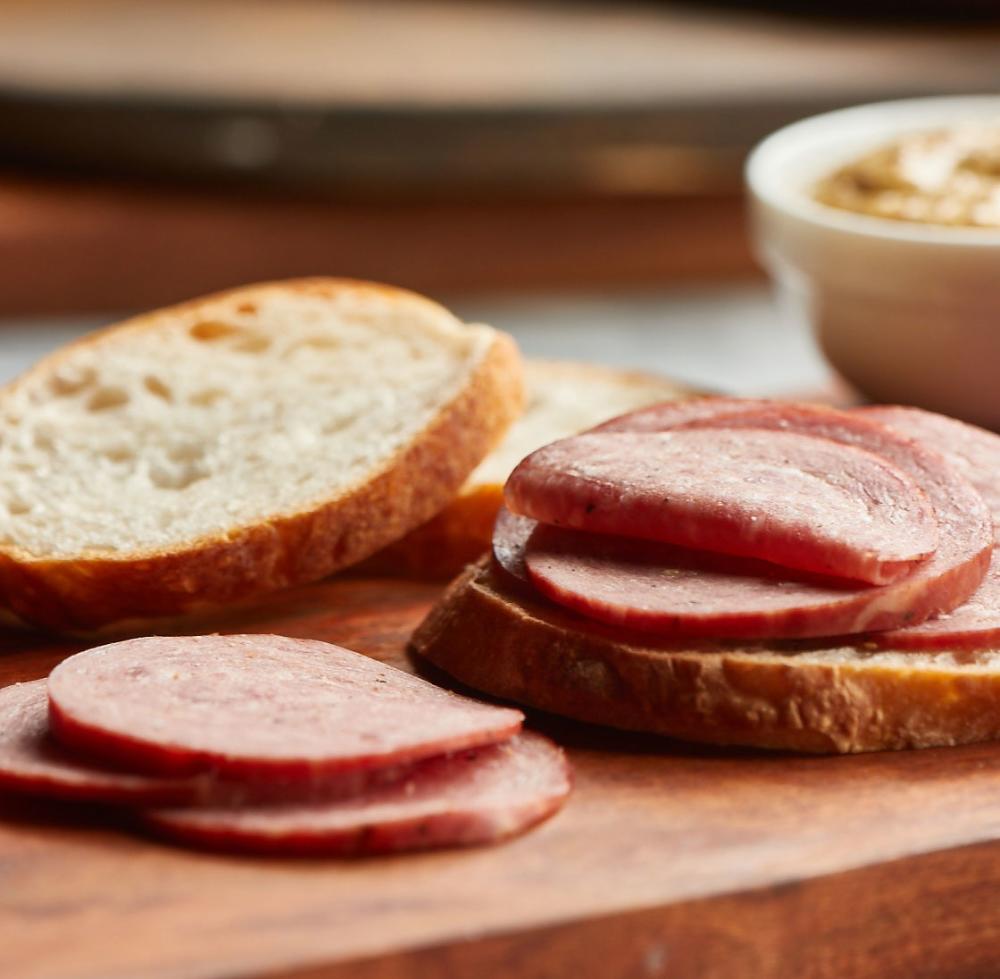
Lebanon Bologna originates from the Lancaster and Reading areas, but most Pennsylvania German communities have their own version of this sweet and spicy circle of processed meat as well. This style of cured meat is thought to be a reproduction of an early 19th-century meat product common among German immigrants specifically from the Rhineland-Palatinate region. Some like it plain, fried in a skillet, or even rolled up with cream cheese inside.

lebanon-bologna
Originating in PA, Lebanon Bologna has made a name for itself far outside the Commonwealth and can be found across the US.
Chorizo

Venison

Pennsylvania pioneers' and hunters' own earthy and smokey contribution to PA charcuterie.

Venison is a staple in the freezers of many Pennsylvanian hunters, as well as a lot of meat markets. Although we tend to think of deer meat as venison, the word actually includes deer, elk, reindeer, caribou, and antelope. In areas where hunting is popular, most butcher shops will clean and process venison, so hunters can have pepperoni, salami, meat sticks, and steaks all year long. If cooked properly, venison doesn't have the strong gamey flavor that scares many people off. Due to the type and amount of fat, elk meat is particularly less gamey than other types of venison. For getting your fill of local elk jerky or pepperoni, the Northern wooded counties, including Elk County, are the best bet.

Chorizo

This contribution of Mexican Pennsylvanians is heavily spiced but not too spicy.

Chorizo is a spicy, pork-based sausage that comes in both fresh and dried forms. In Mexico, chorizo usually contains raw pork and seasonings such as chili peppers and vinegar. Whereas in Spain, chorizo is most often cured and in addition to pork is loaded with garlic and smoked paprika. Although chorizo originated in Spain, it is part of many cuisines, including Puerto Rican, Portuguese, South American, Filipino, and Panamanian. Because of chorizo's popularity, many Italian markets now produce it as well.